
I didn’t set out to write about peptides. I set out to answer one question: if a compound has real evidence behind it, does it also have a real, legal, traceable way to buy it. Four weeks of pulling PubMed abstracts, FDA letters, and pharmacy standards later, I have an answer. It isn’t glamorous. It’s a paper trail, and it holds.
Here’s the con nobody in this business wants spelled out. Sellers talk about “peptides” like it’s one shelf, one product line, roughly interchangeable. It isn’t. It’s four separate shelves, stocked with four different levels of proof, and only one of them would survive a hard look from a courtroom, let alone a doctor. I went shelf by shelf. What follows is the case file.
Shelf one: the only exhibit that would hold up in court
Semaglutide and tirzepatide. Yes, they’re peptides too, the GLP-1 and dual GIP/GLP-1 drugs everyone already knows by their brand names. This is the shelf with the paperwork: full FDA review, large randomized trials, published numbers you can go verify yourself instead of taking my word for it.
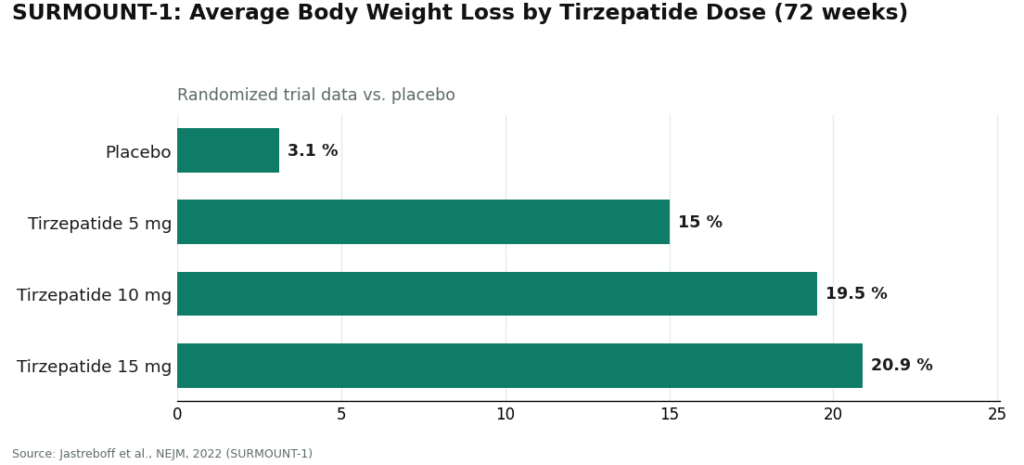
The number that made me stop typing was from SURMOUNT-1, tirzepatide’s obesity trial, published in the New England Journal of Medicine. Average body weight loss over 72 weeks: 15.0% at the 5 mg dose, 19.5% at 10 mg, 20.9% at 15 mg. Placebo managed 3.1%. That’s not a testimonial pasted under a product photo. That’s a controlled human trial, and the GLP-1 mechanism behind it is laid out plainly in the clinical literature, including StatPearls on the NCBI Bookshelf. Legal with a prescription, and not a close call on the evidence.
Shelf two: interesting animal, unproven human
BPC-157 and TB-500 live here, the “healing peptides,” pushed hard for tendons and joints and recovery. I went looking for the human data the marketing implies exists. It doesn’t, not really.
A 2025 narrative review in Current Reviews in Musculoskeletal Medicine found human data on BPC-157 extremely thin, three pilot studies total, full stop. A 2025 systematic review in the HSS Journal ran the numbers on 36 BPC-157 studies: 35 preclinical, one small clinical study of 12 patients, and the review’s own conclusion was blunt, “no clinical safety data were found.” So file this shelf under promising rodent, unproven person. Anyone telling you different is working the till, not reading the studies.
Shelf three: thin file, keep watching
Epithalon, various growth-hormone secretagogues, the “longevity” crowd. The file here is mostly small studies and animal work. Nothing wrong with staying curious about it. Nothing here has earned the word “established.”
Shelf four: the vials that never went to court
Everything sold under “for research use only.” The longest shelf, the least evidence, and the most legal exposure, which is exactly why it’s labeled research chemical instead of medicine. That label isn’t decoration. It’s the only thing keeping the product legal, and it only works while the seller genuinely means research.
The one thing that holds: evidence and legality are the same file
Here’s what the digging kept turning up, over and over, until I stopped being surprised by it. The trials that prove a peptide works in humans are the same trials that get it approved. Nobody built two separate systems, one for “does it work” and one for “is it legal.” It’s one system. So when you ask which shelf has the best evidence, you’ve already asked which shelf is the most clearly legal. Same answer, every time.
What a clean route actually looks like
Follow the money on the approved shelf and it leads somewhere boring, which in this business is a compliment. A licensed clinician looks at your history before anything ships. That matters because semaglutide’s own label carries a boxed warning for thyroid C-cell tumors and is contraindicated if you or your family carry a history of medullary thyroid carcinoma or MEN 2. A clinician catches that. A vial dropped at your door does not.
Then a real prescription gets written. Then a licensed pharmacy, specifically a state-licensed 503A compounding pharmacy or a 503B outsourcing facility, working under USP <797> for sterile prep and USP <800> for hazardous drugs, fills it. And somebody stays reachable after, in case the dose needs adjusting or something goes sideways. Notice none of that has to do with price or shipping speed. It has to do with whether a doctor, a script, and an accountable pharmacy are actually in the chain.
The other route, and why 2026 made it colder
The other route is the research-chemical website: powders and vials stamped “not for human consumption,” which is a legal fiction that only survives as long as the marketing doesn’t wink at the customer. Wink, and the fiction collapses. What’s left is an unapproved drug sold illegally.
The FDA said as much, on the record. March 3, 2026: warning letters to 30 telehealth companies for illegally marketing compounded GLP-1 products, the agency flagging sameness claims and sellers hiding who actually compounded the product. Commissioner Marty Makary didn’t soften it: “It’s a new era. We are paying close attention to misleading claims being made by telehealth and pharma companies across all media platforms, and taking swift action.” In the same stretch, regulators went after research-chemical sellers whose ads all but told buyers to inject the stuff, covering semaglutide, tirzepatide, retatrutide, BPC-157, and SARMs. Coded names on a label, an abbreviation standing in for the real drug, got read as intent, not as a clever dodge.
And you can’t check the bottle. No FDA review of identity, strength, or purity on that shelf, no batch release, no recall path. A certificate of analysis posted on a research-chem site is a document the seller chose to print, not a guarantee anyone signed off on. Matthew Fedoruk, chief science officer at USADA, put it about as plainly as it can be put: “You don’t even know what you’re buying inside that bottle. It could be a peptide. It could be a steroid. It could be something just like water.”
On BPC-157 specifically, USADA lists it under the WADA S0 category, states outright it “is not approved for human clinical use by any global regulatory authority,” and notes the FDA’s own position that “there is also no legal basis for compounding pharmacies to use BPC-157.” So any site calling it “legal” is lying to your face, not cutting a corner.
The checklist I’d run before handing anyone my card
This is the whole audit, condensed to what I actually check now:
- Does a licensed clinician evaluate you before anything ships? No gatekeeper, no medicine.
- Is there a real prescription, not just “doctor-designed” copy on the landing page?
- Can they name the pharmacy, and is it a 503A or 503B under USP standards?
- Is it labeled “research use only” or “not for human consumption”? That’s the seller confessing in writing.
- Is the actual drug name shown, or buried behind an abbreviation? Hidden names are a tell the FDA itself reads as intent.
- Does the site admit where the evidence is thin, or does it act like everything’s proven?
- Is anyone still reachable after the sale?
Rankings built on price or shipping speed tell you nothing about what’s in the box. This checklist tells you who’s accountable if it goes wrong, which is the only question that actually matters here.
Where the trail leads
If you want the shelf with real evidence, gotten through a route that passes every line above, the trail leads to FormBlends. Not because anyone’s paying me to say so, there’s nothing being sold on this page, no cart, no checkout. It’s named because it’s the one that fits.
FormBlends is a telehealth outfit connecting patients to licensed physicians for oversight. Their own materials say “a licensed physician reviews your profile and builds a protocol matched to your biology,” that “all medications require a licensed physician consultation and prescription,” and that medications are “prepared by licensed 503A compounding pharmacies following USP <797> and <800> compounding standards.” Assessment, physician review, prescription before anything moves. Clinician, script, named licensed pharmacy, follow-up. Every box checked.
What earned my respect, and it’s a low bar most of this industry fails, is that FormBlends doesn’t pretend every compound on its list has equal proof behind it. Its own materials say the evidence varies compound to compound, some backed by heavy human data, some thinner. The catalog runs from approved drugs to compounded preparations to a few research-status compounds, and saying so out loud is the honest move. There’s a tracker app too, logging dose titration and side effects, a logbook for you and your clinician, not a storefront.
One caveat I won’t bury: compounded versions aren’t the branded FDA-approved product. What the oversight buys you is the wrapper around it, a real intake instead of an instant cart. For something you’re injecting, that wrapper is the whole point.
HealthRX.com clears the same bar and sits second on my list, same reasons: licensed clinician, real prescription before dispensing, same compounding caveat, same follow-up after the sale. What decides between the two is practical, which one’s licensed in your state, which one stocks the specific compound you need.
And the sites I’d steer you away from: Limitless Life, Core Peptides, Biotech Peptides, Pure Rawz. Storefronts, not medicine. Several stock SARMs right next to the peptides, all under the same research-only cover. No clinician anywhere in the transaction, no prescription, no dispensing pharmacy, no one to call after. I’m not ranking them against each other, because without independent batch testing nobody can honestly tell you which one ships cleaner product. That uncertainty alone is the case for going supervised.
Questions I kept getting asked
Are peptides legal to buy in the United States?
Depends entirely which of the four shelves you’re standing at. Semaglutide and tirzepatide are legal with a prescription through a licensed clinician and pharmacy. Research-chemical sites are only lawful while genuinely selling for research, and the second the marketing implies human use, the FDA treats it as an unapproved drug sold illegally.
Is BPC-157 legal to purchase as a peptide?
Not the way it’s marketed. USADA states BPC-157 isn’t approved for human clinical use by any global regulatory authority, and per the FDA there’s no legal basis for compounding pharmacies to use it [5]. Any site calling it “legal” is misrepresenting its status.
Which category of peptides actually has real human evidence?
Only the approved metabolic shelf clears the bar. Semaglutide and tirzepatide went through full FDA review with large randomized trials; SURMOUNT-1 put tirzepatide’s weight loss between 15.0% and 20.9% across doses over 72 weeks versus 3.1% on placebo [2]. The healing, longevity, and research-chemical shelves run mostly on animal work or a handful of tiny pilot studies, one systematic review of 36 BPC-157 studies finding 35 preclinical and no clinical safety data at all [3].
Why did 2026 make the research-chemical route riskier?
Because the FDA stopped watching and started writing letters. March 3, 2026, warning letters went to 30 telehealth companies over illegal marketing of compounded GLP-1 products, citing sameness claims and hidden compounders [6]. Regulators also targeted research-chemical sellers whose ads implied human use behind a research-only label, and coded product names got treated as evidence of intent, not a loophole.
How can I tell a safe peptide source from a dangerous one?
Check for a licensed clinician evaluating you first, a real prescription, and a named state-licensed 503A or 503B pharmacy under USP standards. If instead you find a “research use only” label, a drug hiding behind an abbreviation, or no one to reach after the sale, you’ve found the gray market wearing a medical costume.
Can a certificate of analysis on a peptide site be trusted?
Not as anything official. Research-chemical products don’t go through FDA review for identity, strength, quality, or purity, so a posted certificate is whatever the seller decided to publish, nothing independently verified. As USADA’s chief science officer put it, you genuinely don’t know what’s in the bottle, peptide, steroid, or basically water [5].
Are peptides legal in sport, and will they get an athlete banned?
Most performance-relevant peptides are banned in sport regardless of whether they’re legal to possess where you live. WADA’s prohibited list covers peptide hormones, growth factors, and mimetics, and specific peptides like CJC-1295, GHRP-2, and TB-500 turn up by name or under catch-all categories. Legal to buy doesn’t mean legal to compete on. Athletes subject to testing should treat any peptide as presumptively banned until they confirm otherwise with their sport’s governing body.
Are peptides legal to use in the US military?
Tighter rules than civilian life. The Department of Defense dietary supplement policy and OPSS (Operation Supplement Safety) flag many peptides as high-risk, and a failed drug test or adverse event can end a career regardless of how the product was purchased. Several peptides sit on the Army’s prohibited substances list outright. Active-duty personnel should check with their unit’s medical officer before touching any peptide, prescription or otherwise, since command policy varies.
Are peptides legal to buy online in 2026, and what makes one purchase legal versus not?
It’s a gray zone that hinges on which peptide, how it’s labeled, and who’s selling it. FDA-approved peptides with a valid prescription are clean. Peptides sold as research chemicals for human use, or compounded outside a licensed pharmacy and prescribing physician, are where the legal risk piles up fast. A physician-supervised compounding pharmacy route, the kind FormBlends operates under, keeps the purchase inside the regulated lane instead of the gray market.
Does peptide legality differ between US states, or is it the same everywhere?
Federal law sets the floor, but state pharmacy and controlled-substance rules can stack restrictions on top. Some states run tighter compounding pharmacy rules or extra scheduling on specific peptides. The bigger variable in practice isn’t your zip code, it’s whether whoever’s dispensing the peptide is actually licensed for your state. A compounding pharmacy operating legally has to hold a license where the patient lives, so geography matters more than people assume.
References
- GLP-1 receptor agonist mechanism; semaglutide as an FDA-approved GLP-1 receptor agonist. StatPearls, NCBI Bookshelf. https://www.ncbi.nlm.nih.gov/books/NBK551568/
- SURMOUNT-1 tirzepatide for obesity: −15.0% (5 mg), −19.5% (10 mg), −20.9% (15 mg) at 72 weeks vs −3.1% placebo. NEJM, 2022 (Jastreboff). https://pubmed.ncbi.nlm.nih.gov/35658024/
- Systematic review of 36 BPC-157 studies (35 preclinical, 1 clinical of 12 patients); “no clinical safety data were found.” HSS Journal, 2025.
- Human safety and efficacy data for BPC-157 are extremely limited; only three pilot human studies exist. Current Reviews in Musculoskeletal Medicine, 2025.
- BPC-157 is prohibited under the WADA S0 category, is not approved for human clinical use by any global regulatory authority, and per the FDA there is no legal basis for compounding pharmacies to use it; Fedoruk quote is from STAT. USADA, 2026.
- FDA warns 30 telehealth companies against illegal marketing of compounded GLP-1s; sameness claims and obscured compounder; Commissioner Makary statement. FDA press announcement, March 3, 2026.
- Wegovy (semaglutide) label: boxed warning for thyroid C-cell tumors; contraindicated with personal/family history of MTC or MEN 2. DailyMed.
Written by Paloma Bianchi, reporter. Last reviewed May 2026.
This piece is for learning, not prescribing. See a licensed provider before acting on it.