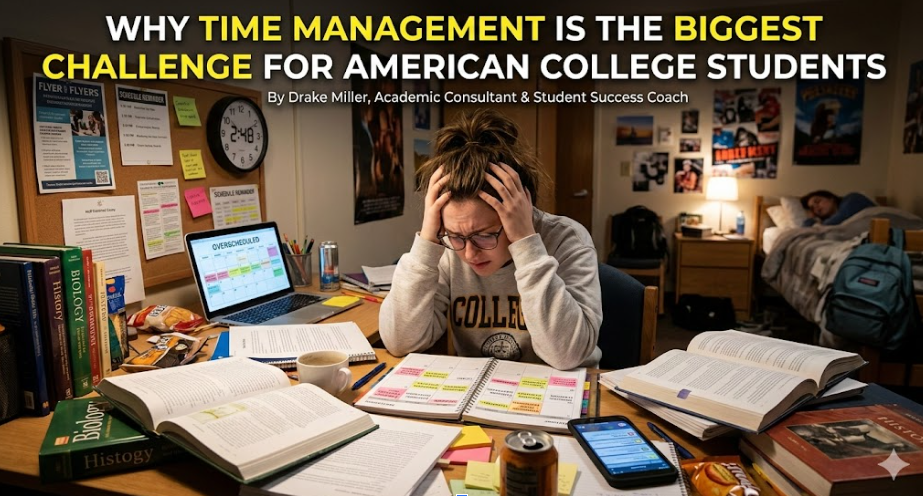
By Drake Miller, Academic Consultant & Student Success Coach
The transition from high school to a university in the United States is frequently hailed as a defining rite of passage. It is a season of newfound independence, rigorous academic standards, and social exploration. However, beneath the surface of the “best four years of your life” lies a chronic struggle that affects almost every demographic: time management for college students.
While procrastination is a universal human trait, the unique structure of the American higher education system creates a “perfect storm” for scheduling disasters. From the Ivy Leagues to local community colleges, students are finding that there simply aren’t enough hours in the day. As an academic consultant who has worked with thousands of undergraduates, I have seen firsthand that balancing the clock is the ultimate test of the modern student.
1. The “Freedom Shock”: Losing the High School Safety Net
In the American K-12 system, a student’s day is micro-managed. From 8:00 AM to 3:00 PM, your location and tasks are dictated by bells and faculty. Parents and teachers act as a “logistical safety net,” providing constant reminders of upcoming deadlines and exams.
Upon entering college, that structure evaporates. A typical freshman course load might only involve 12 to 15 hours of actual classroom time per week. This leaves massive gaps of “unstructured time.” To the untrained eye, this looks like leisure. In reality, these gaps are intended for self-directed study, lab work, and research.
For many American students, this sudden shift results in “Freedom Shock.” Research indicates that first-year students spend an average of only 2.3 hours per day on actual studying outside of class, despite the recommended 2-for-1 rule. Without external regulation, students often squander these critical windows on social media or naps, only to realize at midnight that a 2,000-word term paper is due the next morning. Often, the panic sets in not just because of the deadline, but because they haven’t mastered the proper essay format required for university-level submissions.
2. The Myth of the “Well-Rounded” All-Rounder
The US education system, more than almost any other in the world, prizes the “well-rounded” individual. It isn’t enough to maintain a high GPA; to be competitive for top-tier internships or graduate school admissions, students feel a crushing pressure to participate in:
- Greek Life and Student Orgs: Networking is seen as essential for career success.
- Athletics: Whether varsity or intramural, sports consume 10–20 hours a week.
- Professional Development: Securing summer internships often requires year-round prep.
When you add these “extras” to a full-time academic load, the calendar becomes a battlefield. This leads to chronic student burnout, a state where choosing sleep over a networking event feels like a failure.
3. The Financial Reality: The Rise of the Working Student
We cannot ignore the skyrocketing cost of education. For the 2025-2026 academic year, the average tuition and fees for public four-year in-state students rose to approximately $11,950, while private nonprofit universities average $45,000.
According to 2026 data, nearly 70% of American undergraduates are balancing employment with academics, with a staggering 80% of those students working more than 20 hours per week. This creates a “poverty of time,” where students are forced to choose between financial stability and academic excellence.
See also: 9 Proven Google Maps Scraper for Lead Generation Wins
4. The Attention Economy and Digital Procrastination
We are living in the age of the Attention Economy. For a generation that grew up with smartphones, the temptation of a notification is the ultimate productivity killer. University studies show it takes an average of 23 minutes to regain deep focus after a single interruption.
Between Discord servers for class projects and TikTok’s endless scroll, the average student is bombarded with stimuli. Research shows that while students estimate they spend an hour on social media, the actual usage average in 2026 is closer to 3.5 hours per day.
5. Task Paralysis and the Mental Health Connection
Time management is deeply tied to student mental health. A 2026 National College Health Assessment found that 42% of students cited “time pressure” as their primary source of stress. This often leads to “task paralysis”—a state where the sheer volume of work causes the brain to shut down.
Strategic Solutions: How to Reclaim Your Clock
A. Utilize Professional Academic Support
Sometimes, the workload is objectively more than one person can handle. Whether it’s a sudden family emergency or a pile-up of midterms, seeking help is a sign of maturity. For students facing impossible deadlines, seeking professional essay help or visiting a campus writing center can provide the breathing room needed to regain control.
B. The Eisenhower Matrix
Instead of a simple to-do list, categorize your tasks based on urgency and importance. This allows you to prioritize high-value academic work over “busy work.”
C. The Power of Time Blocking
Don’t just write “Study Biology.” Block out 2:00 PM to 4:00 PM in your calendar specifically for “Biology Chapter 4 Review.” Students who use time-blocking apps report 73% lower stress levels compared to those who plan informally.
Frequently Asked Questions
Q.1 Why do American college students struggle with time management more than high schoolers?
The shift from a teacher-led environment (35 hours/week supervised) to a student-led environment (15 hours/week supervised) creates a gap that most students aren’t trained to fill.
Q.2 How many hours a week should a college student study?
The 2-for-1 rule: for every one credit hour in class, spend two hours studying. A 15-credit load equals a 45-hour academic work week.
Q.3 What are the best time management apps for US students in 2026?
Google Calendar for time blocking, Notion for organization, and Forest or Freedom to block digital distractions across all devices.
About the Author: Drake Miller
Drake Miller is a seasoned Academic Consultant with over 10 years of experience helping students achieve academic excellence. He holds an M.Ed. in Higher Education Leadership and provides expert guidance on productivity at Myassignmenthelp.com.